Showing posts with label Reading. Show all posts

Sunday, April 12, 2020

Reading Notes: More Jataka Tales, Part B

by Ellen C. Babbitt

How the Monkey Saved His Troop
  • As tomorrow is Easter, I found this story quite fitting for the season. The Chief Monkey said "Do not fear; I will save you." Then, he sacrificed himself (by becoming a bridge for his troops to step on) to save the troops. Jesus had the ultimate sacrifice when he decided to save us when He died for our sins. Therefore, the story "How the Monkey Save His Troops" reminded me of Jesus's greatest sacrifice. 
The Hawks and their Friends
  • Lesson: The strong bond of friendship is greatly reliable. "Friends in need are friends indeed."
The Brave Little Bowman
  • Lesson #1: Do not doubt the strength and skill of the little guy. (Your physical appearance does not define your inner strength.)
  • Lesson #2: When it comes to a life/death situation, care for those who were mean to you (or your enemies). 
The Foolhardy Wolf
  • Lesson #1: Do not be cocky. 
    • The wolf thought he was as strong as a lion and thought he could in a sense "trade places" with the masterful lion. However, when he did this, he got killed. Turns out, he is not as strong as the lion. 
  • Lesson #2: Be grateful to those who provide for you.
The Stolen Plow
  • Lesson: You cannot get away from a lie. 
The Lion in Bad Company
  • Lesson #1: Listen to your elders. 
    • I believe there is a fine line in the phrase "listen to your elders." Our parents, or elders, have experienced greater years of life than us and are likely to have good recommendations for us since they want what is best for us. However, I believe that there is a line where we cannot always listen to our parents or else it will feel like we are living our lives for them, rather than for God. The simplest example I can think of is picking a major. If we listen to our parents's pick for a major we will pursue, we might not enjoy and would feel a sense of regret towards them. More so, they are not the ones to purse the major. They are not the ones who will put in the hours of work, take tests, find a job, etc. 
  • Lesson #2: Beware of bad friends.
    • The wolf just left the lion when the lion was in trouble, even though the lion was the one to provide him with good food and risking his life for the food. The wolf never tried to help the lion when he was being killed, instead he just turned away and went home. 
The Wise Goat and the Wolf
  • Lesson #1: It is okay to help others; however, if you have that gut feeling where you are uneasy about the situation, be aware of the surroundings and cautious.
  • Lesson #2: The bad people never win. 
Prince Wicked and the Grateful Animals
  • Lesson #1: Keep your promise.
  • Lesson #2: If you are able, save who you can - poor or rich.
  • Lesson #3: Care for the weaker first. 
Beauty and the Brownie
  • Lesson: Listen, pay attention, and follow instructions. 
The Elephant and the Dog
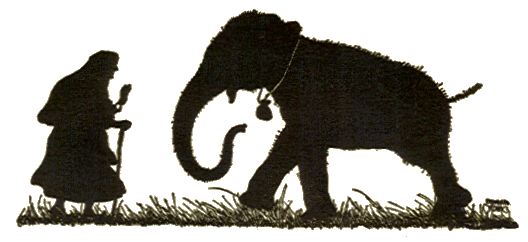
  • Lesson: Best friends should not be separated. 
This image is from my favorite story of the collection, "The Brave Little Bowman." It embraces the theme that no matter your physical size, you can have great inner strength. 


Bibliography: More Jataka Tales, Part B. Author: Ellen C. Babbitt. Illustrator: Ellsworth Young. 1922.

Saturday, April 11, 2020

Reading Notes: More Jataka Tales, Part A

by Ellen C. Babbitt

The Girl Monkey and the String of Pearls
  • Lesson #1: Don't be too proud.
    • The reason the Girl Monkey got caught with the queen's string of pearls was because she became too proud and felt the need to show it off to others. The Girl Monkey's own arrogance is what trapped her. 
  • Lesson #2: All lies will become visible. 
    • The Girl Monkey stealing the pearls was a lie unhidden by the end of the story. 
The Three Fishes
  • My thoughts: This story reminded me of Finding Nemo, with Very-Thoughtful as the dad, Marlin, and the Thoughtful and Thoughtless both being Nemo. Both Very-Thoughtful and Marlin analyzes the situation they are in. When they both foresaw danger, they recommended to the others to avoid that dangerous area. Nemo, Thoughtful, and Thoughtless just wanted to listen to themselves which caused them to enter danger.
  • Lesson: Listen to the wise ones around us. 
The Tricky Wolf and the Rats
  • Lesson #1: Do not deceive others - you will be caught.
  • Lesson #2: Do not doubt the strength and wisdom of the little guy. 
    • Even if the rat is much smaller than the wolf, he was still able catch the wolf in his deceitful act as he outsmarted the wolf and was even strong enough to kill him.
The Woodpecker, Turtle, and Deer
  • Lesson #1: There is great strength in true friendships. 
  • Lesson #2: It is with teamwork that we can succeed. 
The Golden Goose
  • Lesson #1: Do not be greedy. You will get nothing from being greedy. 
  • Lesson #2: While it is good to be giving and caring, make sure people don't abuse your kindness by being naive. 
The Stupid Monkeys
  • Lesson #1: Do not give your work to another.
  • Lesson #2: Ask questions when you are unsure about how to do something instead of proceeding on your own where you might mess the project up entirely.
The Cunning Wolf
  • Lesson #1: Do not consume all your goods without knowing where you will get your next goods from.
    • This could be related to money. It is important not to spend everything we earned at one time, without saving some for later or for emergencies.
  • Lesson #2: Do not lie to get what you want, because you never do. 
The Penny-Wise Monkey
  • Personal note: I really do not agree with the theme/lesson of the story. The story's lesson is: you will loose much when you try to gain a little. When this is put in the context of the Catholic Bible, there are many stories where Jesus leaves the majority of the lamb to find the single missing lamb. I think that everyone/everything has value. So, if this story was replaced with people instead of peas or islands, then I feel like it would be wrong to turn your back on the single person because you already have the majority. 
The Red-Bud Tree
  • Lesson: A single thing  can be seen from different perspectives. 
    • I think this is a very interesting story. We must all remember that when we view a single person or thing, we are all looking at it with our own unique lenses, whether it be at different times, the same time but at different angles, or the same time and angle but with different mindsets due to past history and memories.
The Woodpecker and the Lion
  • Lesson: Ungratefulness really bites.
The Others and the Wolf
  • Lesson: Do not argue for the "best part" when it is already split in half and you get one. Getting one-half is enough. 

"The Red=Bud Tree" was my favorite story because it pointed out a great lesson about perspective. Embracing the realization that everyone has different perspectives but that they are not wrong is an important lesson I want to keep close to myself. 


Bibliography: More Jataka Tales, Part A. Author: Ellen C. Babbitt. Illustrator: Ellsworth Young. 1922.

Monday, April 6, 2020

Reading Notes: Jataka Tales, Part B

by Ellen C. Babbitt
The Wise and Foolish Merchant
  • Lesson #1: Don't trust people so easily.
    • Personal note: I feel that it is good to have faith in people. People are born good. However, there might be people who want to purposely trip you and that is when we have to be cautious. Trust your gut.
  • Lesson #2: The good, observant being always wins. 
    • We must always remember to look outside of ourselves and recognize what is going on around us. 
The Elephant Girly-face
  • Lesson: We tend to listen to those around us. So, surround yourself with those who make you better and guide you in a good direction. 
The Banyan Deer
  • Lesson: Others before self. 
    • My favorite quote is "People change people: How can 'us' help 'them?'" This tale is a representation of how one king deer helped out another deer in need. 
    • Personal note: Also, I have recently been watching the news a lot as I practice social distancing. I have watched a lot of Chris and Andrew Cuomo and I watched a video honoring their late father, Mario Cuomo. He taught people that one is defined by how they take care of others. I think this correlates very well to the tale. 
The Princes and the Water-Sprite
  • Lesson: Know what the good do and also be kind.
The King's White Elephant
  • Lesson: We should always help each other.
The Ox Who Never Envied the Pig
  • Lesson: With patience comes good things.
    • Personal note: Sometimes, we want to rush things, in order to get to the finish line or the top faster. However, we all have our individual path. We must be patient. 
    • Sometimes rushing things will lead us in dangers places.
Grannie's Blackie
  • Lesson #1: Recognize the constants in your life.
  • Lesson #2: Do not forget to thank those who have helped you. (Thank others in the way you deem appropriate for the situation.)
  • Lesson #3: There is greatness in a life of simplicity. 
The Crab and the Crane
  • Lesson #1: Analyze your safety in any situation. 
  • Lesson #2: Take precautions for your safety. 
Why the Owl is Not King of the Birds
  • Lesson: If you try to knock another from the top in order to get there yourself, neither one of you will win. 

This image is from the Jataka tale "Grannie's Blackie." This tale was my favorite from Jataka Tales, Part B. Even though it is not a lesson in the forefront of the tale, I felt that the life Grannie and Blackie lived were simple, and that there is strength in simplicity. Grannie and Blackie really were the best of friends and really loved each other, even if it was never said, it was inferred through their actions. I want to live a life like this. 


Bibliography: Jataka Tales, Part B. Author: Ellen C. Babbitt. Illustrator: Ellsworth Young. 1912.

Reading Notes: Jataka Tales, Part A

by Ellen C. Babbitt
The Monkey and the Crocodile
  • The Monkey outsmarted the Crocodile. 
  • The Crocodile believed everything that the Monkey told him. 
    • Lesson: One should not believe everything that is told to him/her.
How the Turtle Saved His Own Life
  • The Turtle outsmarted those who were about to kill him through reverse psychology. 
    • A proposed way to kill the turtle would actually save the Turtle. So, the Turtle complained about that specific way of "killing" him. Therefore, the men "killed" the Turtle in that way and the Turtle lived.
    • Lesson: Reverse psychology works (sometimes).
The Merchant of Seri
  • Lesson: Greedy people never win. 
  • The grandma was the sweetest in this story. She would give up her only physical remembrance of her late husband to make her granddaughter happy with a gift. 
  • The greedy merchant said that her bowl was not worth much at all. 
  • The kind merchant said it was worth more than everything he had combined. 
    • The kind merchant got the golden bowl.
The Turtle Who Couldn't Stop Talking
  • Lesson #1: We have to know when we should keep our mouth shut. 
    • My thoughts: Every person has a voice. We have the right to use our voice to speak our minds and to make positive change in this world. However, if what we will use our voices for will insult another, we should keep our mouth shut. (Insulting another did not happen in this tale; however, it is a reason why we should keep our mouth shut.) However, I would like to point out there is a difference between keeping one's mouth shut to prevent someone's feelings from getting hurt and keeping one's mouth shut to not insult another.
  • Lesson #2: Don't listen to other people mocking you. Be you.
    • Children were mocking the Turtle which caused him to open his mouth.
The Ox Who Won the Forfeit
  • Lesson: Be kind. Even if you are in a higher position than another, still, be kind. 
The Sandy Road
  • Lesson: Don't every give up. 
The Quarrel of Quails
  • Lesson: When find strength in working with each other.
The Measure of Rice
  • Lesson: Honesty is the best policy.
The Foolish, Timid Rabbit
  • Lesson #1: Do not automatically assume. Check the facts first.
  • Lesson #2: One cannot believe everything they hear. 


The image above is from the World Health Organization's website. During this time of the COVID-19 pandemic affecting our entire Earth, we need to find strength in working with each other, rather than against. The story of the Quarrel of the Quails reminded me of this lesson. 
This link provides other tips to help us during this time of the COVID-19 pandemic from the World Health Organization. 

Bibliography: Jataka Tales, Part A. Author: Ellen C. Babbitt. Illustrator: Ellsworth Young. 1912.

Friday, March 20, 2020

Extra Credit Reading Notes: Epified: Mahabharata Videos, Part B

By: Epified Authors
  • Kunti had a past before marriage with Pandu. 
    • She had a son given to her by the sun god. 
    • She left their son at the river since she was unmarried. 
  • In the present time, Pandu took his two wives and departed for the forest.
    • In his arrogance, Pandu shot an intimate hermit couple.
    • So, the hermit cursed Pandu saying that he will die the moment he tries to become intimate.
    • Kunti then told Pandu that she was able to call on any god and bear their child. So Pandu told Kunti to bear the heirs of Hastinapur. 
  • Kunti called Yama first, the god of truth and death. 
    • Their son was Yudhishthir, who would keep calm in the heat of battle.
  • Kunti then called to Vayu, the wind God. 
    • Their son, Bheem, was very strong and courageous. 
  • Kunti then called Indra, the king of the Devas.
    • Their son, Arjuna, will become one of the greatest warriors.
  • Kunti summoned the ashwin twins for Madri, Pandu's other wife.
    • Madru bore two beautiful sons, Nakul and Sehdev.
  • These five sons became the Pandavas. 
  • Pandu died because he forced himself on Madri, and Madri decided to die too. 
  • Gandhari was jealous of Kunti having children.
  • Ghandhari became pregnant with Dhritarashtra's child, but she bore something lifeless. 
    • Through Ved Vyasa, someone who was like a sage, Ghandhari transformed the lifeless thing into 100 sons. 
    • The eldest son, Duryodhana, along with the other 99 sons, look evil and terrifying to everyone besides their blinded or blindfolded parents. 
  • Kunti and the Pandavas came back to the kingdom of Hastinapur.
  • Duryodhana was filled with jealousy and hated the Pandavas, as they were loved by everyone else. 
    • Duryodhana especially was jealous of Bheem.
  • Duryodhana tricked the Pandavas to go to a lakeside retreat. There, he induced the Pandava's food with sleep-inducing herbs. 
    • When Bheem was deep in slumber, Duryodhana tied his hands and feet and pushed Bheem into the lake. 
  • Bheem, still unconscious in the water, was attacked by snakes. 
    • As the son of Vayu, Bheem woke up and fought the snakes until the snakes tried to help Bheem escape from the water.
    • Bheem landed in a kingdom, deep in the water, and was greeted by their ruler that gave Bheem a magic potion, since he liked him. 
    • This potion made Bheem even stronger and equipped him to fight anything or anyone that comes after him or his Pandva brothers.
  • Bheem returns home and has no recollection on how he landed in the water, so Duryodhana stayed silent. 
  • Bhishma wanted his grandsons to be men of war. 
    • Drona appeared in the lives of Bhishma and his grandsons and he would help them become warriors. 
  • Drona recognized and further developed the talents of the boys.
    • Yudhishthir was an excellent charioteer.
    • Nakul and Sehdev were great swordsmen.
    • Bheem was evidently the strongest and chose the mace as his weapon and could even defeat adults.
    • Arjuna became the perfect warrior. He could use any weapon with ease. The art he chose was archery, as it was the discipline of the mind.
  • Drona's son and Arjuna was picked by Drona to use weapons that controlled all elements. 
    • Arjuna soon found out that Drona's main purpose for seeking their kingdom and training them was for vengeance. 
  • Arjuna ran into an extremely precise archer in the forest named Ekalavya. 
    • Ekalavya told Arjuna that Drona was his teacher. 
    • Turns out, in the past Drona had dismissed Ekalavya from being his pupil, which triggered Ekalavya to train hard to become a great hunter/archer. 
  • Drona asked Ekalavya to cut off his right thumb, and Ekalavya did so.
    • Drona took no pleasure in ending the legend that could have been Ekalavya. 
This image is from Mahabharata Episode 11 - Sons of Pandu from Mahabharata Videos, Part B. I felt that Part B at its core, revolved around the Pandavas; therefore, I felt that it would be appropriate to use an image that has the Pandavas. The five sons in this image are the Pandavas. 

Bibliography: Mahabharata Videos, Part B. By Epified Authors.

Thursday, March 12, 2020

Reading Notes: Epified: Mahabharata Videos, Part A


By: Epified Authors
  • The Mahabharata is a story of karma. 
  •  Shantanu fell in love with Ganga, a river goddess. 
    • Ganga agreed to be Shantanu's wife if he never questioned her.
    • Shantanu agreed.
    • Ganga drowned their first seven babies.
    • Shantanu did not question Ganga until the eighth baby. 
    • Ganga was trying to free spiritual lives that were reincarnated in the eight sons. 
    • Ganga was questioned so she took their last son and left.
  • Shantanu found his long lost son, named Devavrat, and brought him to his palace.
  • Shantanu fell in love again, but to a fisherman's daughter named Satyavati.
    • Satyavati would not marry Shantanu, because her father believed that Shantanu and his first wife's children would be prioritized. 
    • Shantanu did not argue and went home.
    • Devavrat noticed how sad his father was so he went to reason with the fisherman and his daughter, telling them he would not assume his father's throne.
    • The fisherman still did not approve of marriage.
    • Devavrat made a promise that shook the whole world: he vowed to never have any children. In this way, there would be no reason why Satyavati's children would not assume the throne.
    • Devavrat's name turned into Bhishma (he of the terrible oath). He took Satyavati to his father, where his father felt sad about Bhishma's oath.
    • However, Shantanu, for his son's kind intentions, let him decide when he should die. 
  • Bhishma cared for his two half brothers.
    • When one of the brothers died, Bhishma looked for a wife for the other brother. 
    • Bhishma kidnapped three sisters/princesses for his half-brother.
    • Bhishma began the cycle of his death.
  • The oldest princess, Amba, pleaded with Bhishma to let her love another king. She was sure that the other king loved her back and would take her in; but, the other king would not take her.
  • Amba pleaded with Bhishma to take her as his wife. 
    • Bhishma promised to not have any kids so he could not take her as his wife.
  • Amba placed full blame on Bhishma for ruining her life. So, she seeked ways to destroy Bhishma.
    • Only one, the former mentor of Bhishma, would fight Bhishma. They were so equally strong. Only when the mentor withdrew from the fight did Bhishma win.
    • This did not stop Amba from wanting to ruin Bhishma.
  • Bhishma's second half brother died, leaving his two wives both a widow and childless.
  • Satyavati was forced to tell Bhishma of her previous relationship where she bore a miracle child. 
    • The miracle child, Vyass, came to marry and bore the children of the two widows.
    • These two widows were scared of him for they thought he was unattractive.
  • Vyass bore a child with one of the widows when she closed her eyes; therefore, their son, Dhritarashtra, was blind.
  • Vyass bore a child with the other widow when she became weak and pale. Therefore, the son she bore, Pandu, was weak and pale. 
  • Saryavati sent Vyass to bore a child again with one of the widows. However, the widow sent a servant girl instead. This servant girl was not frightened at all, so the son she bore, Vidura, because one of the wisest in the land.
  • Bhishma raised these three boys.
  • A rivalry arose between Dhritarashtra and Pandu that Vidura noticed.
    • There were too many contenders for the throne of Hastinapur.
  • The eldest, Dhritarashtra, became king.
  • Pandu ruled the armies. 
  • It was known that Pandu was the true ruler even though his brother was titled as "king." 
    • Pandu ruled with the wisdom of his brother Vidura.
  • Bhisma seeked a wife for Dhritarashtra.
    • One girl agreed to marry Dhritarashtra and blindfolded herself to be blind too.
      • This outraged her brother, who was wise so he seeked revenge.
  • Pandu also married. He had two wives, Kunti and Madri.
    • Kunti had a secret which would cause more chaos. 
This image shows the overall theme of the Mahabharata. It is told in the beginning of this series of videos, that Karma is the theme that people recognize within the epic when they look closely.


Bibliography: Mahabharata Videos, Part A. By Epified Authors. 

Sunday, March 8, 2020

Extra Credit Reading Notes: PDE Mahabharata, Part D


Reading Notes - Character Analyzation:
  • The following were notes on the scenes that I thought were particularly important to analyze the character Arjuna:
    • Revolted against the idea of fighting against Shikhandin.
      • Arjuna loved Shikhandin as a child so the idea of fighting against him was brutal.
    • Arjuna and Bhishma fought in war.
      • Arjuna's arrows pierced Bhishma which lead to Bhishma's death.
    •  Arjuna was told that his son was slain.
      • Rightly so, this news really hurt him as he wept for his slain son.
      • He then cursed the murderers of his son. 
      • He said that he never wanted to reached heaven if he did not kill Jayadratha (who he believed killed his son) the following day.
      • Jayadratha was told of Arjuna's vow and became fearful.
    • Many people tried to fight Arjuna and the two men who accompanied him (Bhima and Satyaki) before he could reach Jayadratha, including:
      • Duryodhana
      • Karna
      • Bhurishrava
    • Many others fought Arjuna and his men but did not succeed.
    • Finally, Arjuna beheld Jayadratha who was guarded by warriors. 
    • Arjuna easily killed Jayadratha.
      • This killing caused a right of continuous fighting by men who really had no reason to fight.
    • Arjuna asked for a truce and the warriors agreed. 
    • Yet again, Arjuna is in another fight. This time he is in a fight with Susharman when Karna fought against the Pandava army.
      • In my opinion, it seems like Arjuna is a very good, effective, and skilled warrior but he is in too many battles.
    • Arjuna battled against Karna. 
      • This is a close battle because both are seen as mighty.
    • During battle, Arjuna asked Karna to pause the fight because his bow-string was severed.
      • Karna obviously did not care and dismissed Arjuna's request. 
    • Then the opposite situation occurred: Karna asked Arjuna to pause in battle because his chariot sunk into the ground.
      • Differently, however, Arjuna did pause in battle.
      • Krishna pointed out that Arjuna did as Karna asked when he needed it but Karna did not do the same. 
        • As Krishna said this, he spoke the name of Arjuna's son.
      • This triggered Arjuna which caused him to be outraged and shot at Karna's head.
    • Arjuna defeated and killed Karna.
By analyzing Arjuna, he seemed to be a great warrior, as he defeated many. I believe this image really shows this aspect of the character analyzed.


Wednesday, February 26, 2020

Reading Notes: PDE Mahabharata, Part C

By:ArnoldBesantDeveeDuttGanguliKincaidMacfieMackenzieNiveditaSeeger, and Tagore

Reading Notes - Favorite Episodes:
  • Bhima and Hanuman
    • Hanuman was in the epic Ramayana; therefore, it is interesting to see the same character in a different context. 
    • Bhima came across Hanuman.
      • Hanuman was a monkey on the ground that would not get up.
      • At Bhima's request, Hanuman told him of his extraordinary identity.
      • When Bhima did not believe Hanuman, Hanuman became a giant. 
    • Hanuman shared much wisdom to Bhima. 
    • Both found out that they were both sons of the god, Vayu. 
  • Krishna and Karna
    • Karna tries to convince Krishna that if he comes with him, then Krishna will be regarded by the Pandavas as their older brother and Krishna will be king.
    • Krishna is not convinced by Karna and says that he must stay and fight for his friends. 
      • Krishna knows he must stay to fight Arjuna in battle.
      • He believes that fate will decide who is greater when they fight.
    • Even though, Krishna did not do as Karna wishes, they were still in good terms,
    • Both Kunti and Vidura are distrought about the idea of war breaking out between Duryodhana and the Pandavas.
      • Karna is Kunti's eldest son that she hid.
      • However, it is Karna supports Duryodhana. 
      • Therefore, Karna, in a way, is planning to go to war against his brothers.
    • Kunti searched for her son, Karna, in order to apologize about hiding him. 
      • She confessed to him that she was truly her mother and Radha, who found him, was not his mother. 
      • Furthermore, Kunti seemed to plead with Karna to not fight a war against his own brothers, the Pandavas. 
      • Karna was known of having a lowly birth, so Kunti used this opportunity to convince him that he should come back with her and not go against his brothers and that he will be no longer known of lowly birth. 
    • A voice from the sun spoke and confirmed that what Karna said was true. 
    • Karna could not easily forgive Kunti.
      • Karna believed that Kunti was never a mother to him; therefore, he does not see her other sons as his brother.
      • Karna said that Kunti was "too late" in coming forward towards him and request a favor from him.
    • Kunti respected Karna's decision and respectively bid him farewell. She told him to remember that he pledged the lives of his brothers while he is in battle, while also wishing him good health.
    • Karna agreed with Kunti.
    • They both departed from each other. 
This image represents the reaching of Kunti to her son. Similar to this image, their hands do not clasp and they go their separate ways. 

Bibliography: Public Domain Edition of the Mahabharata, Part C  Multiple Authors from Various Sources: ArnoldBesantDeveeDuttGanguliKincaidMacfieMackenzieNiveditaSeeger, and Tagore

Reading Notes: PDE Mahabharata, Part B

By:ArnoldBesantDeveeDuttGanguliKincaidMacfieMackenzieNiveditaSeeger, and Tagore

Reading Notes - Favorite Episodes:
  • The House of Fire
    • Prince Vidura has an interesting character.
      • His mother was a slave girl
      • His half-brother was a king.
        • I wonder how he felt coming from both two two extremes of royalty and slavery. I wonder if he felt just as worthy as his half-brothers for the title "king."
      • He played a really important role in the episode.
        • Prince Vidura was the one who guessed the cruel plot discussed below of Prince Duryodhana. 
    • Varanavata palace:
      • had beautiful furniture and decor
      • was built of wood so it would easily burn
    • Prince Yudhisthira was warned by Prince Vidura of the evil plan of Prince Duryodhana. 
      • Prince Yudhisthira shared with his mother what was told to him by Prince Vidura and told her that he feared that his, his brothers', and his mother's lives were in danger by living in the said palace.
      • He pointed out to his mother that the palace would be set on fire that is why the furniture and tapestries were soaked in oil and the walls and roof of the palace were made of only wood. 
    • Prince Vidura hired a miner to build an escape route in the form of an underground passage for the Pandavas and their mother. 
      • The minder did this very sneakily as he worked at night and covered the passage with wooden planks by day. 
    • Prince Bhima set the guard-house on fire which, through the wind, blew towards the palace. 
      • Therefore, both the guard-house and palace were up in flames. 
    • Coincidentally, a low-caste woman and her five sons came to beg for food and slept at the palace.
      • Unfortunately, this woman and her sons died in the fire.
    • However, the next day the people of the community believed that the low-caste woman and her five sons were Queen Kunti and the Pandavas, and that they died in the fire.
  • The Burning of the Forest
    • Krishna visited the Pandavas and a huge party was thrown.
    • Agni, the god of fire, visited Krishna and Arjuna requesting food. 
      • Agni wanted the two heroes to help him.
      • The two heroes to agreed to help Agni if he got them celestial weapons.
    • Agni got a bow from the god Varuna and many other weapons. 
    • This ignited a battle.
      • Therefore, Indra was defeated.
    • A fire arose and many animals died in flames. 
      • Only a few animals escaped.
    • Agni, in a result, became powerful again.

Bibliography: Public Domain Edition of the Mahabharata, Part B  Multiple Authors from Various Sources: Arnold, Besant, Devee, Dutt, Ganguli, Kincaid, Macfie, Mackenzie, Nivedita, Seeger, and Tagore

Wednesday, February 19, 2020

Reading Notes: PDE Mahabharata, Part A

  • King Shantanu married Ganga. 
    • Ganga was a goddess assuming human form, but King Shantanu thought she was fully human. 
  • Ganga made the promise of casting her children into the Ganges river prior to assuming human form. 
    • Fufilling her promise, Ganga threw each of her and King Shantanu's children into the river.
    • Shantanu stayed silent as she did this to their first seven children; however, by the eighth child,l he became furious at Ganga for her action.
    • Ganga left Shantanu with their eight child because Shantanu yelled at her.
    • Ganga returned and gave back their son, Devavrata, to Shantanu.
  • Shantanu later fell in love with Satyavati. 
    • Satyavati was a human twin who was born from a fish. 
      • She was born from King Uparichara, who was the King of Chedi, when he was flying through the sky and his semen fell into the river which was swallowed by a female fish. 
      • A fisherman caught the fish and two children came forth - one boy and one girl.
      • When this was presented to the king, the king only took the boy. The girl, Satyavati, stayed with the fisherman and his wife.
      • Satyavati bore a child name Vyasa with the rishi Parashara. 
        • However, the rishi with his powers made Satyavati virgin againm even after the birth of their child.
        • Satyavati agreed to bore a child in order to have her fish smell replaced with a sweet fragrance. 
    • Shantanu and Satyavati married and had two sons Chitrangada and Vichitravirya.
  • Devavrata promised the father of Satyavati that he would not claim the throne after his father passed so that Satyavati's sons will become king. 
  • Chitrangada died soon after he assumed throne.
  • Vichitravirya assumed throne but needed to find a wife. 
  • Devavrata found Vichitravirya three wives: Amba, Ambika, and Ambalika. 
    • Amba left the kingdom to go to who she loved.
    • Ambika had a blind son, Dhritarashtra.
    • Ambalika had a pale son, Pandu.
  • Pandu assumed throne.
    • He had two wives, Kunti and Madri.
      • Kunti bore a child that she sent into the river.
    • Besides the son Kunti sent into the river, Pandu had 5 sons: Yudhishthira, Bhima, Arjuna, Nakula, and Sahadeva. 
  • Pandu died and Madri followed along.
  • Dhritarashtra assumed throne and married Gandhari, who bore a hundred sons.
    • Their eldest son, Duryodhana, was born terribly crying so men told Dhritarashtra to kill him for it was a bad sign and the boy will turn evil.
  • The Pandavas (the five sons of Pandu) and Kauravas (decedents of Kuru) lived together in the kingdom but there was always tension between them. 
    • Leader of the Pandavas: Bhima.
    • Leader of the Kauravas: Duryodhana.
  • Duryodhana poisoned Bhima.
    • Bhima came back to life as the king of the nagas (or snakes).
  • Drona and Drupada were best friends that drifted apart. 
    • Drona was found by Bhishma to train the princes to fight and their fight would be agains Drupada.
  • After, many wanted to be trained by Drona. 
    • Drona welcomed everyone except Ekalavya, the son of the rajah of the robber Bhils.
  • Tournament between Bhima and the Pandavas versus Duryodhana and the Kauravas.
  • Drona with the princes fought Drupada.
  • Arjuna captured Drupada which angered Duryodhana.
    • Out of jealously Duryodhana planned on setting the palace on fire when the Pandavas and their mother was asleep.
This image is a cartoon representation of the jealousy Duryodhana has against Arjuna for capturing Drupada.


Bibliography: Public Domain Edition of the Mahabharata, Part A Multiple Authors from Various SourcesArnold, Besant, Devee, Dutt, Ganguli, Kincaid, Macfie, Mackenzie, Nivedita, Seeger, and Tagore

Thursday, February 13, 2020

Reading Notes: More Ramayana - Sita Sings the Blues, Part B

By: Nina Pale

These notes are over the film Sita Sings the Blues, Part B

  • Sita tells Rama that she is pregnant.
  • Rama's reaction to Sita telling him that she is pregnant results in him banishing Sita from the kingdom for two reasons:
    • 1.Rama lost the trust of his subjects when Rama took Sita back even if she has been in the possession of another man. 
    • 2. Rama still doubts of Sita's pureness.
      • In my opinion, it is wrong that Rama cares more about his reputation as seen by others rather than protecting his wife. I understand that Rama is seen as this perfect man who obeys and follows his "duty" as a king. However, isn't his "duty" to also love and protect his wife? If he keeps basing his actions on what his thinks other people would want him to do, then he has lost a lot of his own character. Speaking as an audience member, I think Rama should be a strong, independent man who disregards the small opinions of others that he cannot control. Furthermore, Rama from the start LOVES Sita, and it baffles me that he can change his thoughts so quickly.
  • A very pregnant Sita thinks about killing herself because she thinks it is bad karma that she lives a banished (by her husband) life.
    • However, Valmiki rescues her and Sita tells him the whole story.
  • Valmiki helps Sita give birth.
  • Sita gives birth to twins!! Her two sons are Lava and Kusha.
  • Valmiki teaches Sita's twins songs of praise about Rama.
  • Sita is still obsessed with Rama and she is still wanting to do anything or wait for so long for Rama. 
  • Rama goes into the forest and hears singing voices and finds out it is his sons singing.
  • Rama immediately invites his two sons to come back to the kingdom to rule alongside with him for many hears to come. 
  • However, Rama would not let Sita come back unless she proves her purity again.
    • In order to prove her purity, Sita calls on Mother Earth to take her back if she is pure. 
    • Mother Earth takes Sita and, therefore, Sita leaves Rama behind with a single tear.


The three above images may be a stretch to relate the 2020 film of "To All the Boys P.S. I Still Love You" to Ramayana; however, I feel like there is a connection. (SPOILER ALERT to the movie!) Rama throws Sita to the side when pretty much she served him no more good. Similarly, Lara Jean (female on the right in the third picture) throws John Ambrose (guy in the white tux) to the curb when she didn't need him anymore and thought she had something better elsewhere.


Bibliography: Sita Sings the Blues, Part B by Nina Paley. Created 2008.

Tuesday, February 11, 2020

Reading Notes: More Ramayana - Sita Sings the Blues, Part A


By: Nina Pale

These notes are over the film Sita Sings the Blues, Part A.  There is a great focus on Sita and I love that!
  • Rama is banished from his father's kingdom.
  • Sita said to Rama "If you go, I go."
  • Sita is head over heels for Rama. --> Even with no money, she is still thankful.
  • Rama defeats any threat to safety they have in the forest.
  • Ravana is king of Lanka who seems to be a really good guy. 
    • --> His only flaw is taking Sita away from Rama.
      • --> Taking Sita away from Rama is instigated by Ravana's sister, because she wanted to hurt Rama for killing their people and animals.
        • Ravana's sister convinces him by saying "Sita is the most beautiful woman in the world."
  • Sita is kidnapped by Ravana and he takes her to Lanka
  • Sita leaves a "trail" for people to find her by dropping her jewelry.
  • Hanunan's sole purpose is to help Rama.
    • -->Rama asks Hanunan to find Sita.
  • Sita stays under a tree in Lanka either:
    • weeping
    • worshiping Rama
    • rejecting Ravana over and over again 
  • Hanunan arrives to Lanka and searches for Sita.
    • --> As Hanunan looks for Sita, he also sets the kingdom of Lanka on fire.
    • --> Hanunan finds Sita but Sita does not go back to Rama with him because she wants Rama himself to find and rescue her.
      • Sita's want for this is perceived in different ways.
        • --> Her action is seen as a mistake.
        • --> Her action is seen as wanting to glorify Rama because he would be the one to save her and Rama could fight and defeat Ravana.
  • Rama organizes an army of half-monkey/half-human creatures to fight against Ravana's army to get back Sita.
  • Rama's army defeats Ravana's army.
  • Rama and Sita's first fight (or it seems to be the first) occurs:
    • However, Rama doubt Sita's purity because she has been in the kingdom of Ravana.
    • Sita is hurt and argues her purity.
    • Rama believes Sita through being convinced by a washerman.
    • So Rama believes Sita is pure and begs Sita to forgive him for doubting her.
    • Sita forgives Rama.
  • Sita is so happy they have made up. --> "No rainbow without rain."

Rama and Sita forgive each other after (what seems to be) their first fight.


Bibliography: Sita Sings the Blues, Part A by Nina Paley. Created 2008.

Thursday, February 6, 2020

Reading Notes: PDE Ramayana, Part D

by Multiple Authors from Various Sources: M. Dutt, R. Dutt, Gould, Griffith, Hodgson, Mackenzie, Nivedita, Oman, Richardson, and Ryder.

Notetaking Strategy: Focus on Favorite Episode
  • My favorite episode in this reading was Episode 77. Rama Crowned King.
    • It is about time that Rama assumes to be the heir of his father's throne!
    • Fourteen years have passed in the eventful forest where there seemed to always be a battle that had to be fought. 
    • The people of Ayodhya rejoiced that Rama has returned and will become their king again. 
      • They dressed Rama and Sita in silky nice clothes and gave them the gemmed and jewelled seat. 
      • They searched and brought back sacred water from distant places so that the priests may pour it on and bless Rama and Sita with the sacred water. 
      • They placed the crown of the Maharajah along with jewels on top of Rama's head. 
      • Even an umbrella was put over Rama so to provide shade for the fearless king. 
      • More so, gifts of golden garland and wreath of pearls were sent to Rama in celebration. 
      • Therefore, upon Rama's return to his kingdom, a full-out party was released amongst the people. There was music (and I assume dancing) and gifts upon gifts for King Rama.
    • Not only the rich celebrated Rama's return, but even the poor (in spirit and in goods). 
      • Even those who had every right to be sad about what is going on in their own lives, for example the widows, were no longer crying in their sorrow.
      • Robbers, cheats, and deceivers were did not dare lie.
      • Neighbors loved each other!
    • As the rich and poor people celebrated, so did Mother Earth. 
      • The trees provided much fruit for the people.
      • The rains came which enabled a rich pasture with ample crop and fertile soil.
  • This is my favorite episode because Rama, Lakshmana, and Sita was forced into a hard life by a jealous peer. Their life in the forest tested them in every way. There was battles after battles, and even though they won these battles, it can for sure take a toil on these people. Rama has lived his life with class. He could have been filled with anger against his father and stepmom for causing him to live a tough life in the forest, but he did not. Rather, Rama filled his heart with love for his wife, Sita, and brother, Lakshmana, instead of any anger. Therefore, I just feel like it was about time that he is celebrated for his wonderful attitude and superior strength. 


Bibliography: Public Domain Edition of the Ramayana, Part D; Multiple Authors from Various Sources: M. Dutt, R. Dutt, Gould, Griffith, Hodgson, Mackenzie, Nivedita, Oman, Richardson, and Ryder.

Extra Credit Reading Notes: PDE Ramayana, Part C

by Multiple Authors from Various Sources: M. Dutt, R. Dutt, Gould, Griffith, Hodgson, Mackenzie, Nivedita, Oman, Richardson, and Ryder.

Notetaking Strategy: Focus on Plot

  • Rama and Lakshmana was discovered by Sugriva, King of the Monkeys, and Hanuman, his best servant monkey who can change his appearance into anything he chooses.
  • Sugriva has a problem of his own and wants Rama and Lakshmana to help him. 
    • Sugriva has been banished from his kingdom by his older brother, and along with banishment he lost his wife to his brother.
  • Rama encouraged Sugriva to set up a fight with his brother, Vali. 
    • Rama and Sugriva made a pact that if Rama and Lakshmana help Sugriva defeat his older brother, Vali, in return Sugriva shall send all his animal servants to look for Sita.
    • Sugriva and Vali fought, and, of course, through Rama's help Vali died.
  • Sugriva became king of the palace; however, he did not fulfill his promise of finding Sita for the longest time. It was through Lakshmana's threat to Sugriva, that Sugriva began to act on his promise. 
  • A couple of monkeys came across Sampati, the brother of Jatayu, who was the courageous bird who tried to help Sita against Ravana. Through Sampati, the monkey's learned that Sita at a far-away place called Lanka.
  • Hanuman became the brave monkey who would look for Sita at Lanka.
    • Throughout Lanka, Hanuman looked for Sita. However, Hanuman struggled to find Sita in any of the rooms in the kingdom.
    • Finally, however, as Hanuman was giving up and exiting the palace, he crossed the Ashoka grove. There, he found the beautiful Sita.
    • Before Hanuman could be seen Ravana rushed to Sita and demanded from her to be his wife. However, the courageous Sita strictly said "No!" as she knew in her heart that Rama should be coming for her. Ravana in return gave her two months to live unless she becomes his wife and then left.
  • Hanuman approached Sita and said he was sent by Rama.
    • Sita did not believe him at first. It was when Hanuman showed Sita the ring that Rama gave him to show her, did she finally believe.
    • Hanuman offered to carry Sita away, but Sita, in her modest purity politely declined and said she only wanted to be touched by Rama.
  • However, Hanuman was captured and by the servants of Ravana. 
    • Through his capturing, however, Hanuman's cords that bound him was loose. 
    • He pretended that he was still in his chains as he planned his great escape.
  • Hanuman escaped and in the process burned half of Lanka down. He managed to find Sita and they went home to Rama together. 
    • This left Ravana in anguish. He looked for council in others in what should be done to Hanuman and Rama. It was his third warning to just let Sita go back to Rama or else the strong Rama will attack him: first warning by Sita, then by Hanuman, and thirdly by Ravana's own brother Vibishana, who in result was banished from the kingdom by Ravana.


This image represents the courage of both Sita and Hanuman in their respective ways. Being courageous was a theme of this reading and especially shown by them.

Bibliography: Public Domain Edition of the Ramayana, Part C; Multiple Authors from Various Sources: M. Dutt, R. Dutt, Gould, Griffith, Hodgson, Mackenzie, Nivedita, Oman, Richardson, and Ryder.

Friday, January 31, 2020

Extra Credit Reading Notes: PDE Ramayana, Part B

by Multiple Authors from Various Sources: M. Dutt, R. Dutt, Gould, Griffith, Hodgson, Mackenzie, Nivedita, Oman, Richardson, and Ryder.

Notetaking Strategy: Focus on One Character: Lakshmana
  • Personally, I think Lakshmana is an underrated character. He truly is a hero with great strength and love. This is first seen in Part A of PDE Ramayana when Lakshmana would not leave Rama's side when Rama was exiled; but, his Lakshmana's character further evolves in Part B and it is evident he is a good man. 
    •  Lakshmana's physical strength
      • He fought in battle with any enemy that faced him. 
      • He fights with courage and he never backs down nor does he even seems to think about backing down.
      • He wins all his physical battles.
      • Bharata, his older brother, regards him as "powerful"."
      • He protects his brother, Rama, and especially his sister-in-law, Sita. 
    • Lakshmana's ability to love
      • Lakshmana's "love story" is the love between brothers. He will do anything for his brother, Rama.
      • He is also very obedient to Rama. Throughout the episodes, I have imagined Lakshmana as a big, tough guy with huge muscles and cannot be told what to do. However, in Episode 30. Battle with Khara, Lakshmana was just told once by his brother to leave his side in battle to take Sita to a safe place and guard her. I did not think Lakshmana would listen. I at least thought he would put up a fight against Rama. However, he did not. Instead, he was obedient and followed his brother's command immediately.
      • Besides when Rama told Lakshmana to not help him fight a battle in Episode 30, Lakshmana ALWAYS fought by his brother against the enemies. Truly, these enemies were never Lakshmana's enemy. These enemies were usually against Sita or Rama (or the fact that Rama and Sita were married); however, since Rama fights in battle, Lakshmana will aid him. 
      • Lakshmana is never jealous. Personally myself, as a younger sibling, I easily get jealous of the attention that my older sibling gets. 
        • Rama is always seen as the hero. Rama is seen as the sinless man who practically has a halo on his head. This is recognized by many.
        • With a sibling who is seen as perfect, I am surprised Lakshmana does not have anger or jealousy towards Rama. Instead, Lakshmana only has undeniable love for his brother.
  • While I do think Lakshmana is an unsaid hero, he obviously is not perfect and has his own faults. His biggest fault in my opinion was leaving Sita alone in Episode: 34. The Chase. Eventhough, Sita pushed Lakshmana to leave her (in order to find Rama who Sita was worried about), Lakshmana should have stayed. 
    • Lakshmana already had a gut feeling that sometimes there were deceitful deer in the forest who lures people away, and it was likely the deer Sita wants and Rama is after is actually a dangerous deer. He should have trusted his gut. 
      • We should always trust our gut.
    • At first, Lakshmana argued against Sita when Sita told him to go after Rama. However, he then caved and did as Sita wanted and went looking for Rama. It was soon after that Ravana took Sita away from the brothers. 

While this image is not from any story in Ramayana, Part B, I think it accurately describes the love between the two brothers, Lakshmana and Sita. They will always fight beside each other, for each other.

(The Picture Ramayana, circa 1916-1924)


Bibliography: Public Domain Edition of the Ramayana, Part B; Multiple Authors from Various Sources: M. DuttR. DuttGouldGriffithHodgsonMackenzieNiveditaOmanRichardson, and Ryder.

Tuesday, January 28, 2020

Reading Notes: PDE Ramayana, Part A

by Multiple Authors from Various Sources: R. Dutt, Gould, Griffith, Mackenzie, Nivedita, and Oman

Notetaking Strategy: Focus on One Character: Sita

  • Sita was not introduced until Part A, Section 8. Her introductory scene was laying eyes on Rama and Lakshmana and having love at first sight with Rama.
  •  Next scene is having a Sita "won" by Rama. 
    • Personally, this was one part of the story that I was not aligned with. I understand that this story was taken place in a different place and time. However, I do not like the fact that Rama wins Sita's hand in marriage. (Rama does this through showing his physical strength in bending a bow.) 
    • While I do think it is good that Rama works hard to lift the bow and that can show Sita that this man will work hard for her; however, I do not like the aspect of Rama earning Sita just because he worked hard.
  • Another important scene with Sita was her and Rama's wedding day. 
    • However, in my perspective, I felt like Sita was just a side character of the wedding story. While it was her big day and she should have been a main character alongside Rama, she did not have dialogue in the story nor were her opinions and thoughts spoken of. Personally, I wish that Sita's emotions were showed more. For example a question that arose in my head was, "Did Sita feel nervous or excited for the wedding?"
  • Sita truly loves and cares for Rama.
    • This is especially shown in Chapter 16 and 17.
    • In Chapter 16: Rama is Banished, Sita invoked the gods to bless and protect Rama as Rama headed to speak with his father.
    • In Chapter 17: Rama Goes into Exile, Sita was persistent and would not let Rama go and live in the woods for 14 years by himself. No matter the opposition of Rama, Sita said that she would rather live without material riches in the woods but with Rama, her love, than be without Rama in a kingdom.
    • She knew a wife and husband shall stay together, which I LOVE.
  • Sita grew up rich and with the finest clothes and had difficulty parting with it in exchange for something less silk-like. 


My favorite part of Ramayana, Part A was Chapter 17: Rama Goes into Exile as it shows the strength and bond of the marriage and love of Rama and Sita.


Bibliography: Public Domain Edition of the Ramayana, Part A; Multiple Authors from Various Sources: R. DuttGouldGriffithMackenzieNivedita, and Oman

Thursday, January 23, 2020

Reading Notes: Week 2 Anthology

The Turtle and the Geese by Ellen C. Babbitt

  • Story from Two Turtle Jatakas from the version in Jataka Tales by Ellen C. Babbitt
  • Character Charting:
    • Geese
      • Strength: Inviting - Geese invited the Turtle to their home
      • Strength: Having Foresight/Being Wise - Geese knew to remind the Turtle not to talk
      • Weakness: Secretive- Geese simply told the Turtle not to talk but gave no explanation.
      • Personal Note: There are always people in our lives that are wise and know more about a particular topic because they have had experience. In a weird way, the Geese remind me of God. I believe God is all-knowing and He asks of us to do certain things with no explanation. We simply must trust in Him and that he is pointing us in the right direction by following through with what He is asking. 
    • Turtle
      • Weakness: Did not follow through with promise - The Turtle talked even though he promised not to. This immediately led to his death.
      • Strength: Trusting - The Turtle did not question the Geese about why he was forbidden to talk.
      • Strength: Defending himself - While the act of defending himself led to his death, I applaud that the Turtle defended himself against the bullying village children.
      • Personal Note: I completely understand the actions of the Turtle, even if it led to his death. I appreciate that he did not let himself and his character be stepped on. However, the Geese seemed to have foresight which led to the single promise the Turtle had to make. All the Turtle had to do was follow through with that promise. If the Turtle had questions about the promise, then he should have asked and sparked a conversation. Instead, he dismissed the idea of a conversation and just thought he could get to the final destination without keeping his promise.
    • Village Children
      • Weakness: Mockery - The village children made fun of Turtle being carried my two geese and a stick. 
      • Personal Note: These children remind me of the people in one's life that purposely tries to trip us. Unfortunately, we all face bullies at some point of our lives. However, when in this situation, we hope to keep our head up and walk over their foot that is trying to trip us and make us fall.